Corn-tamination Series: Mushrooms

When my corn allergy became more sensitive, I found that I started reacting to mushrooms purchased from the grocery store. But I could eat them if I grew them myself, or purchased them from a cultivator at the farmers’ market who grew his mushrooms on sawdust.
It’s been suggested by another mushroom cultivator  that I could just be allergic to Agaricus mushrooms, but I react to shiitakes grown on corn medium and don’t react to shiitakes grown on a straw medium, so there’s evidence that the medium does matter, at least for me. I suspect the reaction is more due to cross contamination rather than allergens actually making it into the fruiting body.

Portobellos, buttons, and criminis are the same species of mushroom in different stages of maturity and they have to grow on compost. That can mean just about anything, as long as it’s rotted. I don’t know what the smaller operations will find to be useful or cheap for compost but I am positive that the BIG guys use some kind of corn medium because I react to the mushrooms, and actually within the last year or so I have begun to have airborne reactions from being on the same block as some of the bigger agaricus growing operations.

Other mushrooms like oyster mushrooms, shiitakes, morels, basically the “weirder” mushrooms all grow on cellulose, so typically wood cellulose and grains such as barley and rye, but could also be corn cobs, kernels, or husks.

The mushrooms will not be rinsed with anything generally as water will make them slimy but I imagine that they could *possibly* be sprayed with some kind of preservative. I have no evidence that anyone does so, it just seems possible. The trays the mushrooms come in could contain corn fibers. If the mushrooms are covered with plastic, the plastic could be corny or could be dusted with corn starch.

A nice article on how different types of mushrooms are grown. 

Another possible issue if you are purchasing mushrooms from some vendors is the baskets they come in: Those green composite baskets cause problems for a lot of people.

Cross Contamination With Gluten and Other Allergens

For a long time I was able to eat mushrooms from a farmers market vendor who grows theirs on barley and sawdust. Unfortunately I began to have a gluten (but not corn) reaction to the mushrooms, intermittently. I think the issue is cross contamination with the growth medium. Not sure if the cross contamination is handling/storage of the mushrooms and growth medium together, or if it’s coming through in the mycelium. I don’t think that it’s in the actual fruiting body of the mushroom, but I do think that it’s possible the mycelium still contains traces of gluten, especially in a short growth cycle where it’s possible the mycelium of the mushroom is not completely consuming the grain and associated gluten.

Growing Your Own Edible Mushrooms

I’m busy right now now with other priorities so I’m just not eating mushrooms, but I do plan to begin growing my own soon. In the past I have had great luck with mushroom growing kits and sawdust spawn from Fungi Perfecti.  The Oyster Mushroom kits are darn easy even for the total newbie, but they also do *some* phone tech support if you need it. Generally it’s best to hit up the blogs and forums, and perhaps even buy a book or two to get you started.

Note that I have not looked at the “corn safety” of the plastic sheeting or plastic bags of their kits, just know that they were fine for me when I was medium-sensitive. I bet they would be happy to answer questions about their materials. When I got more sensitive I was already pretty experienced at growing mushrooms. Rather than getting a pre-made kit,   I just put together my own safe materials for a fruiting chamber and got some sawdust spawn to colonize my own safe growth medium.

Corn-tamination Series: Berries

I can eat some organic berries and not others. It’s not the berries themselves: it’s corn.  Giant brand organic strawberries were no good, but Driscoll’s I can have. Driscoll’s and some french-canadian brand of blueberries I can do, but not Naturipe organic blueberries. And I can’t do any berries that have the soaker pads in them, no matter who they came from. I’ve also reacted to locally-picked organic berries at the farmers’ market.  Even the Driscoll’s berries that I can tolerate, I only tolerate *most* of the time, not all of the time. Once in a while I’ll get a carton or two that are no good and have to return or give them away.

A little googling tells me that the list of pesticides and fungicides allowed on organic berries is lengthy. Pyganic (pyrethrin) is just one of the sprays. The active ingredient is 2% of the mix and undisclosed “other ingredients” that smell like vegetable oil according to the MSDS makes up the other 98%. Considering some of my experiences with trying to get details on the “other ingredients” of products like this I doubt I’d be able to find out exactly what’s in it, but I think it’s safe enough to assume corn-based solvents and coating agents.

I asked a friend who has worked at a berry farm about other ways that corn could get in. My first thought was that the berries might be rinsed with citric acid, as some bagged salad greens are, and here’s what he said (paraphrased):

The berries aren’t rinsed as they will start to deteriorate quickly if rinsed. They ARE however gas-ripened with ethylene gas (from corn ethanol). Strawberries are grown on black plastic (could be corny) sheets for weed control. Berries are watered with PVC drip hoses, and there are TONS of fertilizers that are organic but corny. There are also many kinds of organic dusts and pest control sprays that could be corny.

Berres are often picked with corn starch-powdered gloves, possibly even latex, and they are also shipped in cardboard containers which could  contain corn fibers.  Those green composite baskets cause problems for a lot of people. There is also a very real possibility for cornfields right next to where the berries are grown.

For grocery store berries, there are also the soaker pads- I don’t know what the pads themselves are made out of, but pads like that often contain corn-derived citric acid as a preservative/anti-microbial.

So there ya go! Only about a million ways for corn to get in!

ER Safety: Emergency Medical Treatment With a Corn Allergy

Learn something from this post? Feel free to show your appreciation with a tip! The info on my blog is always free, so you are never obligated. But it is always appreciated.
Buy Me a Coffee at ko-fi.com

Updated 2/21/2017

Emergency Medical Instructions – For Mobile

Emergency Medical Instructions – Letter size (designed for front and back)

Corn products are in many  medical supplies. In particular, dextrose and glycerin (both usually from corn) seem to be in a number of injected drugs, and those two have in the past caused me severe–even anaphylactic– reactions when they come in contact with a mucus membrane. The last time I allowed a glycerin-based gel to touch my lip, everywhere it touched swelled immediately, and my tongue swelled on that side of my face, all the way into my throat. It was terrifying.

Injections aren’t the only danger, either. Disinfectants, lubricants, preservatives, and disposable  paper products also contain enough corn to give me at least a small problem, if not a dangerous reaction. Even the sugar used to treat dehydration and restore electrolyte balance is corn-based.

Even those without such severe and immediate reactions can and have experienced significant discomfort as a result of corn in medical products. GI reactions, migraines, or rashes may not block off your airway, but they are definitely unpleasant and can still be dangerous.

The idea that someone could kill me while trying to save me keeps me up at night, so I’ve been asking a lot of questions trying to figure out how a medical responder can avoid killing me when trying to save me. I don’t have all of the answers, but I have a plan, and I hope it works.

  1. Wear some kind of medical alert bracelet. I have a MedicAlert brand bracelet, the largest size available, to fit as much as possible, which still isn’t enough. The text reads: TREAT WITH IV SALINE. ANAPHYLAXIS TO LACTATED RINGERS, GLUCOSE,DEXTROSE, SUCROSE, PCN.  (PCN is short for penicillin.) I have a membership so that I can use MedicAlert’s online medical history service but there are definitely other services out there that do similar, and plenty of other jewelry-only type vendors.
  2. Keep a thorough but succinct treatment plan in several places on your person. The document below is my best attempt at this. It is formatted to fit on a letter-sized sheet of paper, front and back. I also want to make small laminated cards to keep in my wallet and a version on an In Case of Emergency app on my mobile phone.
  3. Keep a more detailed medical history on your person and/or an online repository. There are also USB medical bracelets that you can buy and wear.
  4. Consider putting together a hospital bag ahead of time for inpatient stays that contain necessities.

I don’t know how well this will work, but I really hope it will at least keep me alive in a medical emergency.

And, of course, I am sharing what I have so far. The following is a publicly available Google Doc that you can copy to your own google doc and alter as you like. My doc includes notes on what you should change to customize for yourself. And of course it only covers a corn allergy, so if you have other allergies, such as penicillin, that need to be mentioned, it is only a starting point. Here it is:

Corn Allergy Emergency Medical Instructions – Letter size (designed for front and back)

Corn Allergy Emergency Medical Instructions – formatted for mobile

I’ll update here as I get more formats set up for wallet cards and mobile apps.  Different ICE apps have different features, but they all usually provide a widget so that the info can be accessed from the lock screen without unlocking the phone. This is important to me since I have all of my email and social networking accounts hooked up to my phone. While I’m not particularly concerned that an EMT would stop trying to safe me to try to hack into my stuff, I think that my phone could end up in ANYONE’s hands if I were incapacitated.

Note that the document is only meant to cover emergency room procedures- not routine medical care, nor longer term or inpatient procedures. I now have a post about longer hospital visits that is very much work-in-progress.

Dealing with Skeptics

Something that comes up often in any medical situation is skepticism that corn can be the root cause of all the reactions to various chemical derivatives. Rather than argue this in an emergency situation, the following tactics have worked in the past:

  • Claim chemical sensitivity: Say that you react to “preservatives,” “dyes,” and “additives.” People are for some reason more likely to believe that one can have a non-specific sensitivity to these things than that one can be reacting to the corn source of them.
  • Claim multiple sensitivities: For some reason people are more willing to believe that you are separately allergic to citric acid, potassium benzoate, polyethylene glycol, glycerine, and a dozen other ingredients than that you are only allergic to them when they are derived from corn.
  • Use the term “sensitivitiy” or “adverse reaction” rather than “allergy” unless you have a positive IgE test result to show. “Allergy” means something specific in the medical world, so if your adverse reactions are not proven to have IgE as a mediator, it’s only going to hurt your case to insist that you have an allergy. Adverse reactions can still be severe, so make sure that you stress that you have had severe adverse reactions to corn derivatives, preservatives, and excipients in medications.
  • Remain calm and be as logical as possible. If you seem emotional, you will not be taken seriously. I realize that the fear and the coursing adrenaline in emergent situations make this difficult. Try to breathe. If they are insisting that there is no choice other than a product or medication you fear you will react to, ask if they can try a small amount or do a skin test to make sure it’s safe. Also ask what their protocol is for severe reactions or anaphylaxis. This is both so that you understand what will be done if you react, and to remind them that anaphylaxis is a possibility.

Learn something from this post? Feel free to show your appreciation with a tip! The info on my blog is always free, so you are never obligated. But it is always appreciated.
Buy Me a Coffee at ko-fi.com

Corn Free Probiotics: Home Ferments

As I’ve mentioned before, you won’t find a corn-free commercial probiotic supplement. If you do, I would LOVE to hear about it, but so far I have not.

Now, that does not mean that you can’t have probiotics. You can make your own. People always look at me funny when I say that. I think it’s because they don’t understand what probiotics are. They are microorganisms that live in your gut. Yes, they are little bugs, but the good kind. I know people think that because the  usual probiotic supplement comes in a pill format it must be dead and sterile, but actually they’re just  hella lab-processed versions of something you can *totally* do yourself, and control the ingredients on.

Lots of people are concerned about the safety of home ferments, and you do need to exercise basic caution. You  need to use clean equipment and follow instructions until you really understand what you are doing. If you  have a mold problem in your home, meaning lots of pesky aspergillus spores floating around, you probably want to reconsider wild fermentation. Definitely do your own research on safety in home ferments, but my reading tells me that that home ferments are pretty safe.

Here’s the round-up of probiotic foods and beverages you can make yourself at home.  This is *not* a how-to post- you can find all kinds of videos and blog posts about how to actually make these ferments all over the internet. This is just a rundown of the options out there to give you an idea of what might work for you and what you are interested in researching.

Continue reading “Corn Free Probiotics: Home Ferments”

Corn Free Antibiotics

There is no such thing as a 100% corn free antibiotic. BUT, if you have an infection and need a safe-ish antibiotic right now, here are some possible options:

Rocephin (Ceftriaxone) Injection

Many corn allergic folks have had success with a rocephin injection. I have never personally done this, but here is the package insert. It looks like it can be prepared in water or in ethanol. Ethanol is corn alcohol, so request that the solution be in water, and double-check the package insert in the office to be sure that the inactive ingredients look safe. (Cross reference with the corn allergens list.)

Additionally the rocephin injection is often combined with a numbing agent, lidocaine, which can be skipped. Preservative free lidocaine (Xylocaine is one brand) can be corn free but you will need to check package inserts, not all clinics have the corn free version in stock.

There may also be other injections that could be safe. Check using these resources: how to find inactive ingredients of medications.

Update 2015: I personally have gotten this injection… There are a few different brands but basically I got a Ceftriaxone injection that was a powder with only the active ingredient. My doc mixed it only with distilled water. It hurt a LOT. I am a grown up with a fairly high pain tolerance, and I was crying a little.  I did have a mild/moderate reaction from it that passed within 3 hours, and I believe it was a corn reaction from the growth medium, but I don’t really know. I recommend pre-treating with any safe antihistamines you have before getting the injection.

Zithromax Brand

The Zithromax brand, 600 & 250mg,  are very corn lite.  Not corn free, but I’d take them in a pinch. The generics all seem to have corn starch, so brand name only.

Cephalexin

There are many corn-lite formulations of cephalexin.

Here’s a list of all the formulations of cephalexin and their inactive ingredients. Depending on sensitivity, you may be able to get away with taking one that just has as few ingredients as possible and no corn starch.

If you need pills and can’t tolerate potentially corny derivatives, you will need to have your antibiotics compounded. Here’s some good advice on how to do that. 

Note that much like probiotics, antibiotics are not 100% corn free just due to what they are. They are a product of microbes and are almost always grown on a medium containing corn sugar.

So with that in mind, I would avoid antibiotics as much as possible, opting for natural remedies as much as you possibly can. But sometimes you have no other choice, and when that’s the case, be aware that even if you get the “cleanest” antibiotic you can get your hands on, you will still be getting some corn, and prepare yourself accordingly.

Tips For Asking About Corn In Products

There are a lot of ways to ask a vendor or manufacturer about what is in their product. I’ve been doing it on and off, with varying degrees of success, for about 6 years. I don’t have it down pat, but I have definitely learned a thing or two about what hasn’t worked for me.  It’s not that there’s really a “right'” way to do this: the right way is the way that gets you good information that you can make safe decisions with. But for me, given the style that I related to people in, there are some things that seem not to work well for me and some that seem to work better.

Less Effective: “Is there any corn in this?”

When I was first diagnosed with a corn allergy, my format for asking this question was something like: “Hi there, I am allergic to corn. Is there any corn in your product?”

That worked for me for a little while. I’d ask, and people would say no, and I’d eat the food and be fine. Until the time I asked that of a famous bratwurst company, and they incredulously replied no, there was no corn in their bratwurst, and I believed them. I reacted, and badly. The customer service representative that answered my email apparently was envisioning whole kernels of corn being added to the meat grinder, and given that image, truthfully answered the question. What he did not realize is that their product contained corn dextrose.

Beyond just corn sugars and ingredients directly made from corn, ingredients that are commonly products of fermentation such as citric acid cause terrible reactions for more sensitive corn allergics because they are grown on a medium containing corn sugar. Customer service representatives will not know exactly how these ingredients are made as they are just reading from a script or information sheet.

Continue reading “Tips For Asking About Corn In Products”

Finding Inactive Ingredients of Medications

[Finally updated April, 2024]

This post used to contain a walkthrough of a resource that no longer exists, NIH Pillbox. Unfortunately it no longer exists and hasn’t for years. All we have now is NIH’s DailyMed database, which is an archive of package inserts for all kinds of medication and medical supplies.

I am a software engineer and have poked at creating a search engine based on DailyMed’s API, but I’m also chronically ill and have a full time job, so I haven’t done much with it. Email me if you want to get involved, which is to say probably do most of the work with some suggestions from me. (But hey maybe I’ll get motivated to do more if someone else is working on it too.)

Meanwhile, here is the long, slow, arduous way to find some potential options if you need a non-compound medication that is free from your allergens.

Go to: https://dailymed.nlm.nih.gov/dailymed/

Search for a drug. If you are trying to find a potentially safe version of a drug you need to take, put in the generic name. For example, rather than “Keflex”, search for the drug name “cephalexin.”

Screenshot 2024-04-02 at 4.29.42 PM

This is deeply terrible and I am sorry. What you will have to do at this point is to just… open a bunch of tabs for each product, until you get tired of opening tabs. I know.

Screenshot 2024-04-02 at 4.31.22 PM

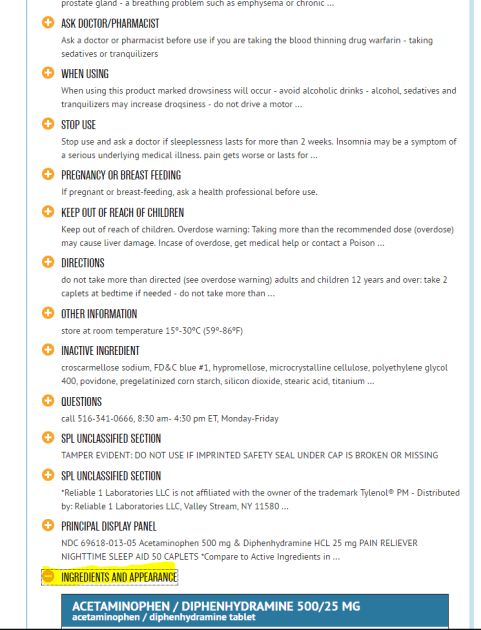
For each med listed on DailyMed, there should be an “ingredients and appearance” section on the bottom.

dailymed1

The inactive ingredients should be listed in this section.

dailymed2

Corn Allergy Safety At the Dentist

I just got back from my first corn-free dental cleaning, and no reactions! My last dental cleaning was a bit over 6 months ago, and two weeks after that visit, I had a Tom’s of Maine toothpaste that contained corn-derived sorbitol send me to the hospital. As you can imagine, I pushed back my upcoming appointments for fillings so that I could figure out how to get them without landing in the hospital. Fortunately the office manager at my Seattle-area dentist is just a wonderful human being, and was able to help me navigate this successfully. Our process was convoluted, but we eventually got to the right place for my specific needs. However, if I had to do this all over again, this is what I would have her do:

  1.  Get a list of all products that could be used during a dental cleaning, filling, or root canal. This includes gloves, cotton or gauze, paper bibs, and other “incidental” products, as well as products that are also directly used in your mouth, on your lips, or injected.
  2.  Get the package insert/MSDS for each. Make photocopies and just hand me the sheaf of them to go over.
  3.  Study up each of the products on my own, using google/the Corn Allergens list, and questions to the Facebook Corn Allergy and Intolerance group or the Delphi Avoiding Corn Forums to determine what should be safe.
  4.  Return with a list of approved items to use. And a gift to show my appreciation.
  5. Show up on the day of my appointment with an instruction sheet to remind them of what should and shouldn’t be used, and what to do if a reaction occurs.

Following is a list of the possible places to check for corn at the dentist. This list is written with the most sensitive in mind, including those who react to water treatment chemicals, so not all may apply to you:

  • The “bib” put around your neck could be dusted in corn starch. Bring your own cloth towel.
  • Water for rinsing or swishing. Water could be filtered through a corny filter or include corny softener salts. Additionally an additive is sometimes used to help plaque rinse away better, which could be corny. Bring your own safe water and rinse and swish with that.
  • Sonic cleaning devices which spray continuous water. Find out where the water comes from and if you are in doubt, ask for the “old school” polish and scraping tools to be used.
  • Chapstick or vaseline on  used during a procedure to keep lips from cracking. Bring your own safe.
  • Mouthwash. Skip or bring your own.
  • Dentifrice/tooth polish. Skip or bring your own. I use bentonite clay from living clay co for tooth polish.
  • Sanitizer used on tools will be corn derived. Wash and rinse them in safe soap and water. This includes the cup that holds the dentifrice during a cleaning- I kept having a mild reaction until we realized that and rinsed the prophy cup.
  • Floss- the wax can be corny. Bring your own.
  • Cups/containers for water and other supplies, including the cup that tooth polish is kept in. Bring your own containers or ask that the containers they use be rinsed first.
  • Gloves- can be dusted with corn starch. Make sure they use unpowdered.
  • Numbing injections- inactive ingredients can contain corn, usually dextrose. Check inactive ingredients.
  • Filling adhesive.
  • Dissolvable sutures are corny. Use the non-dissolvable and have them rinsed before use.
  • Xrays: Film or covering over the receiver if digital. If you tolerate any plastic bags such as ziploc brand, bring those along to cover anything being placed inside your mouth if possible.
  • Intravenous solution: Lactated ringers and dextrse are corny. Request saline only.
  • Topical numbing agents: Skip them entirely, they are pretty much all corny.

Numbing Injections

Carbocaine is the “standard” that most corn allergy folks have used, but there are other possibly safe injections. Septocaine and Zorcaine have been used by many but may cause issues for those with sulfa allergies. Preservative free lidocaine, both with and without epinephrine, has been used safely as well. In all cases, check the package insert and compare the ingredients against the corn allergens list before using.


Here are my instructions for a dental cleaning. You will need to personalize to yourself, especially the second half, but it’s a good place to start. 

Here is the last instruction sheet I used for a filling.

Things that could be problematic but are notably NOT covered in my instructions: airborne contact with perfumes, fabric softeners, etc, and the bite contact sheet they use after a filling to see if your teeth are coming together right. I did not check the MSDS on that sheet, just let them use it.

How NOT to Treat Eye Infections

Spoiler alert: This is more of a narrative of my mishaps, and does not end in a solid conclusion about the correct way to handle eye infections with a corn allergy.

I don’t know why, but for some reason after going most of my young/young adult life without an eye infection, I have gotten bacterial pinkeye TWICE in the last three years! The first time the cause was obvious- a coworker had children with the infection, and I managed to catch it from her despite my best efforts at handwashing and avoidance.

This time? I don’t even know what happened. I wasn’t doing things considered bacterially risky such as hanging out with petri dishes small children or rubbing my eyes excessively. Probably I just touched the wrong grocery cart or doorknob and then had an itch, and my body has been pretty susceptible to infection lately due to a convergence of allergens. Now, it is totally possible to have non-bacterial conjuctivitis, however given the onset and symptoms, I felt pretty sure it was bacterial.

Continue reading “How NOT to Treat Eye Infections”