[Finally updated April, 2024]
This post used to contain a walkthrough of a resource that no longer exists, NIH Pillbox. Unfortunately it no longer exists and hasn’t for years. All we have now is NIH’s DailyMed database, which is an archive of package inserts for all kinds of medication and medical supplies.
I am a software engineer and have poked at creating a search engine based on DailyMed’s API, but I’m also chronically ill and have a full time job, so I haven’t done much with it. Email me if you want to get involved, which is to say probably do most of the work with some suggestions from me. (But hey maybe I’ll get motivated to do more if someone else is working on it too.)
Meanwhile, here is the long, slow, arduous way to find some potential options if you need a non-compound medication that is free from your allergens.
Go to: https://dailymed.nlm.nih.gov/dailymed/
Search for a drug. If you are trying to find a potentially safe version of a drug you need to take, put in the generic name. For example, rather than “Keflex”, search for the drug name “cephalexin.”

This is deeply terrible and I am sorry. What you will have to do at this point is to just… open a bunch of tabs for each product, until you get tired of opening tabs. I know.

For each med listed on DailyMed, there should be an “ingredients and appearance” section on the bottom.
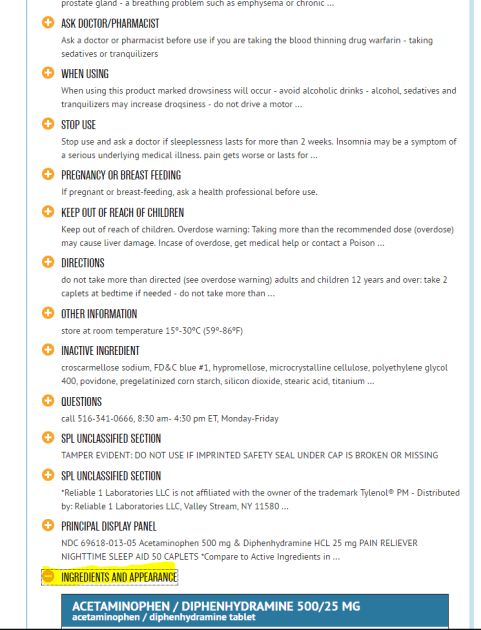
The inactive ingredients should be listed in this section.

 Corn Allergy Girl
Hello, I am not allergic to corn, but I am to Red Dye 40. I have not idea how I hit upon your page, but the information on the NIH “Pillbox” was a God send tonight. The antibiotic ordered for me has red dye and the doctor’s office is gone for the weekend. I researched the medication and between the pharmacist and myself we found a replacement. A white tablet of the same medication at a higher dose, but I will be able to cut it to the correct dose.
Thanks,
MCP
It should be noted that manufacturers can CHANGE their inactive ingredients. Your sites are excellent for research but I always ask my pharmacist to show me the manufacturer’s product insert to check the inactive ingredients. I have a severe allergy to milk proteins and this can be (not always, unfortunately!) a lifesaver.
I am looking for a MS drug that is safe. Do you know anything about Disease Modifying Drugs (DMD)? I’m trying to research all the inactive ingredients and was just wondering if there is already a list?
Thank you!
The NIH pillbox site was retired. The info is no longer being updated.
I know. I’m working on a search engine in my spare time, which is to say I barely have 100 lines of code written.
So now it’s just the backup method, searching through DailyMed haphazardly. Sorry. If you know anyone that wants to work on an opensource project, I’m writing it in Elixir/Phoenix.
Two years later, I have finally edited this post to reflect the fact that it walks you through a site that no longer exists.
That search engine I’ve been working on has not really been progressed upon at all.
I assure you I am doing my best here but it’s been a rough couple years sigh.